info@skylaneimmigration.ca | +1-204-491-0000 Services in English, Punjabi, Hindi and Urdu
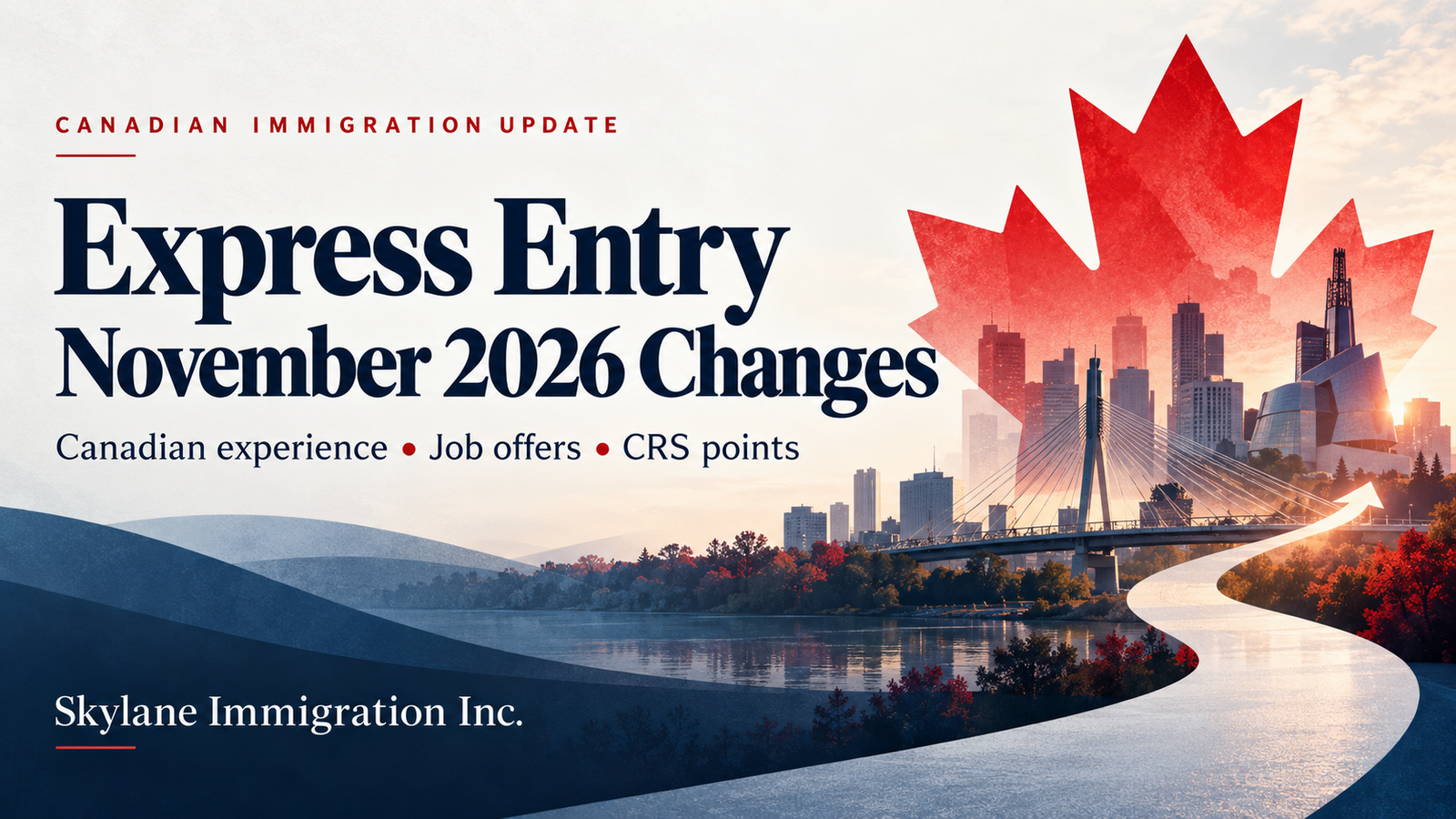
Express Entry Changes


Express Entry Changes take effect: Nov 03, 2026
Canada has announced changes to Express Entry that may increase some applicants’ immigration points. The changes focus on eligible Canadian work experience and qualifying job offers in occupations that IRCC classifies as high-wage.
The three main changes are:
- Some candidates will receive extra points for Canadian work experience in listed high-wage occupations.
- Some candidates will receive points for a qualifying job offer in a listed high-wage occupation.
- An LMIA will no longer be necessary for qualifying Express Entry job offers
Your actual salary does not decide your occupation’s high-wage tier. Also, you cannot add the Canadian experience route and the job-offer route together.
First understand Express Entry and CRS points
Express Entry manages applications for three federal immigration programs:
- Canadian Experience Class, or CEC.
- Federal Skilled Worker Program, or FSWP.
- Federal Skilled Trades Program, or FSTP.
It also handles some Provincial Nominee Program applications. First, you must meet the requirements of an eligible program. IRCC then ranks eligible candidates using the Comprehensive Ranking System, or CRS. A higher score or in-demand occupation may improve your chance of receiving an Invitation to Apply, commonly called an ITA.Qualifying for the pool, receiving an invitation, and obtaining permanent residence are separate steps. These changes do not guarantee an invitation or approval.
Who should pay attention to these changes
| Your situation | What the changes may mean for you |
| You have eligible Canadian experience in a listed high-wage occupation | You may qualify for an experience bonus. |
| You have a qualifying Canadian job offer in a listed occupation | Your offer may qualify for points without an LMIA. |
| You have both qualifying experience and a qualifying offer | IRCC will use whichever scoring route gives you more points under the new factor. |
| Your occupation does not appear on the high-wage list | Your eligible Canadian experience can still earn regular work-length points. |
| You live outside Canada | A qualifying Canadian offer may help. Foreign work experience alone does not qualify for the new Canadian experience bonus. |
| You rely on a job offer for program eligibility | Review the offer even if its occupation does not qualify for high-wage points. |
Candidates who receive no extra points should still monitor their position in the pool.
What a high-wage occupation means
IRCC uses the National Occupational Classification, or NOC, to identify occupations. Each occupation has a five-digit code.For these changes, IRCC looks at the occupation’s median wage across Canada. The median is the middle wage when wages are placed in order. IRCC compares that occupational figure with its overall Canadian workforce wage benchmark.
IRCC places eligible NOCs into three tiers:
- Highest tier: at least twice the benchmark.
- Middle tier: at least 1.5 times, but below twice, the benchmark.
- Entry tier: at least 1.3 times, but below 1.5 times, the benchmark.
The list taking effect on November 3, 2026 uses data from 2023 to 2025. IRCC uses Job Bank, Labour Force Survey and Census data, and assigns each occupation the highest tier it reached during the relevant three-year period.You check your NOC against IRCC’s list. You do not compare your own hourly wage with a provincial wage threshold. A higher salary alone cannot move your NOC into a higher tier.
How points for Canadian work experience will work
This route combines two amounts:Regular points for the length of eligible Canadian experience + any qualifying high-wage experience bonus.
You receive the highest bonus you qualify for. You do not add 20, 40 and 70 together. Having several years of high-wage experience does not multiply the bonus.Eligible work can include part-time equivalents, separate periods, and more than one listed occupation. IRCC counts overlapping jobs only up to 30 hours a week in total. You cannot use overtime to turn six months of work into one year. The full-time equivalent is 1,560 hours over at least 12 months.
For example, six eligible full-time months in the highest tier plus six in the middle tier may support the 40-point bonus. They do not support 70 points because the candidate has only six months in the highest tier.
The maximum for this experience route is:
- 150 points without an accompanying spouse or partner: 80 regular points plus a 70-point bonus.
- 140 points with an accompanying spouse or partner: 70 regular points plus a 70-point bonus.
These are maximum amounts for this factor, not points everyone receives and not the maximum total CRS score.
Which work experience counts
The announcement generally refers to eligible Canadian experience from the previous 10 years in TEER 0, 1, 2 or 3 occupations. Existing eligibility conditions still apply. Special provisions cover certain physicians providing publicly funded medical services.
Do not confuse this with CEC eligibility. CEC generally requires qualifying Canadian experience within the three years before applying. The new points rules do not extend that CEC window to 10 years. CEC also excludes certain work, including unauthorized work, unpaid work, work during full-time studies and most self-employment.
IRCC says the existing skills transferability rules will continue. These are separate CRS rules that assess combinations of factors such as education, language and work experience.
Again, the occupation’s tier determines these points. Your individual salary does not determine the tier.
The offer should be recent, in writing, and explain the duties, pay and employment conditions. A work permit alone does not count as a job offer.
IRCC will still assess whether:
- The employer operates a real, active business.
- The business reasonably needs the position.
- The employer can meet the offer’s terms.
- You can perform the work and will likely accept and carry out the job.
- The employer complies with relevant employment and recruitment laws.
What removing the LMIA requirement actually means
An LMIA is a labour market assessment that employers may need when hiring a foreign worker.
Starting November 3, a qualifying Express Entry offer will not need an LMIA for the new points. Having an LMIA will not provide extra CRS points or priority. An offer may involve a current or new position with a current or new employer, provided it qualifies.
IRCC also announced a temporary public policy for qualifying offers used to establish FSWP or FSTP eligibility. It covers candidates invited on or after November 3, 2026, who meet the policy’s conditions.
Can a job offer help if the occupation is not on the list
Yes, potentially. Program eligibility and CRS job-offer points answer different questions.
An offer outside the high-wage list may still help establish FSWP or FSTP eligibility if it meets that program’s requirements. It will not earn points under the new high-wage job-offer route.
Who should review or update their Express Entry profile
IRCC says candidates seeking job-offer points should review and update the required offer information before November 3, 2026.
Review your profile if:
- You have a potentially qualifying offer that you have not included.
- Your employer, job duties, NOC, dates or offer terms have changed.
- Your work history contains errors or missing information.
- You gained or lost an offer that affects your eligibility.
What happens after November 3
IRCC will automatically recalculate existing profiles. It says this may take up to two weeks and that it will pause invitation rounds during recalculation. Do not assume your score will change immediately on November 3 or rely on a particular draw restart date.
After recalculation, review your score breakdown. Check whether IRCC used the experience route or offer route and whether the profile contains the facts needed to support that amount.
What happens if IRCC changes the occupation list later
IRCC says it will use the occupation tier that applied when it issued your ITA. That applies if the occupation later moves tiers, leaves the list or joins it.
Common misunderstandings to avoid
- “My salary is high, so I qualify.” Check the NOC list. Your personal wage does not determine the tier.
- “Every engineer, nurse or electrician gets the same points.” Different NOCs can fall into different tiers or outside the list. Check the exact occupation.
- “I can add the offer points and Canadian experience points.” IRCC compares the two scoring routes and uses the higher amount.
- “A listed NOC guarantees points.” You still need qualifying Canadian experience or a qualifying offer.
- “My overseas experience earns this new experience bonus.” This particular bonus requires eligible Canadian experience.
- “No LMIA means I can work without a permit.” The Express Entry change does not grant work authorization.
- “My occupation is not listed, so I cannot use Express Entry.” The high-wage list does not replace program eligibility rules.
Disclaimer