
info@skylaneimmigration.ca | +1-204-491-0000 Services in English, Punjabi, Hindi and Urdu

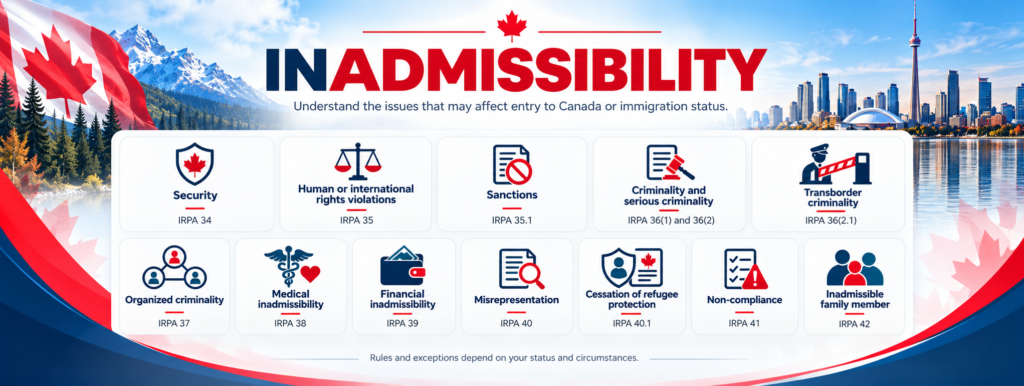
What is Inadmissibility?
Inadmissibility is a legal finding under the Immigration and Refugee Protection Act (IRPA). The finding bars a foreign national or permanent resident from entering or staying in Canada.
Criminality and serious criminality
Past Conviction
Canada or overseas
Foreign Offence
With or without conviction
Immigration Concern
Letter, refusal or hearing
Understand how a criminal record or past conduct affects your plans for Canada. Get a clear assessment before you travel, apply, or respond to immigration concerns. we review your circumstances, explain the legal issues, and identify the evidence and options relevant to your case
Legal question | Serious criminality, Section 36(1): Permanent residents and foreign nationals. | Criminality, Section 36(2): Foreign nationals only. |
Conviction in Canada | A federal offence with a maximum prison term of 10 years or more, OR a federal offence for which the court imposed more than 6 months of imprisonment. | One indictable federal offence, OR two federal offences from separate occurrences. |
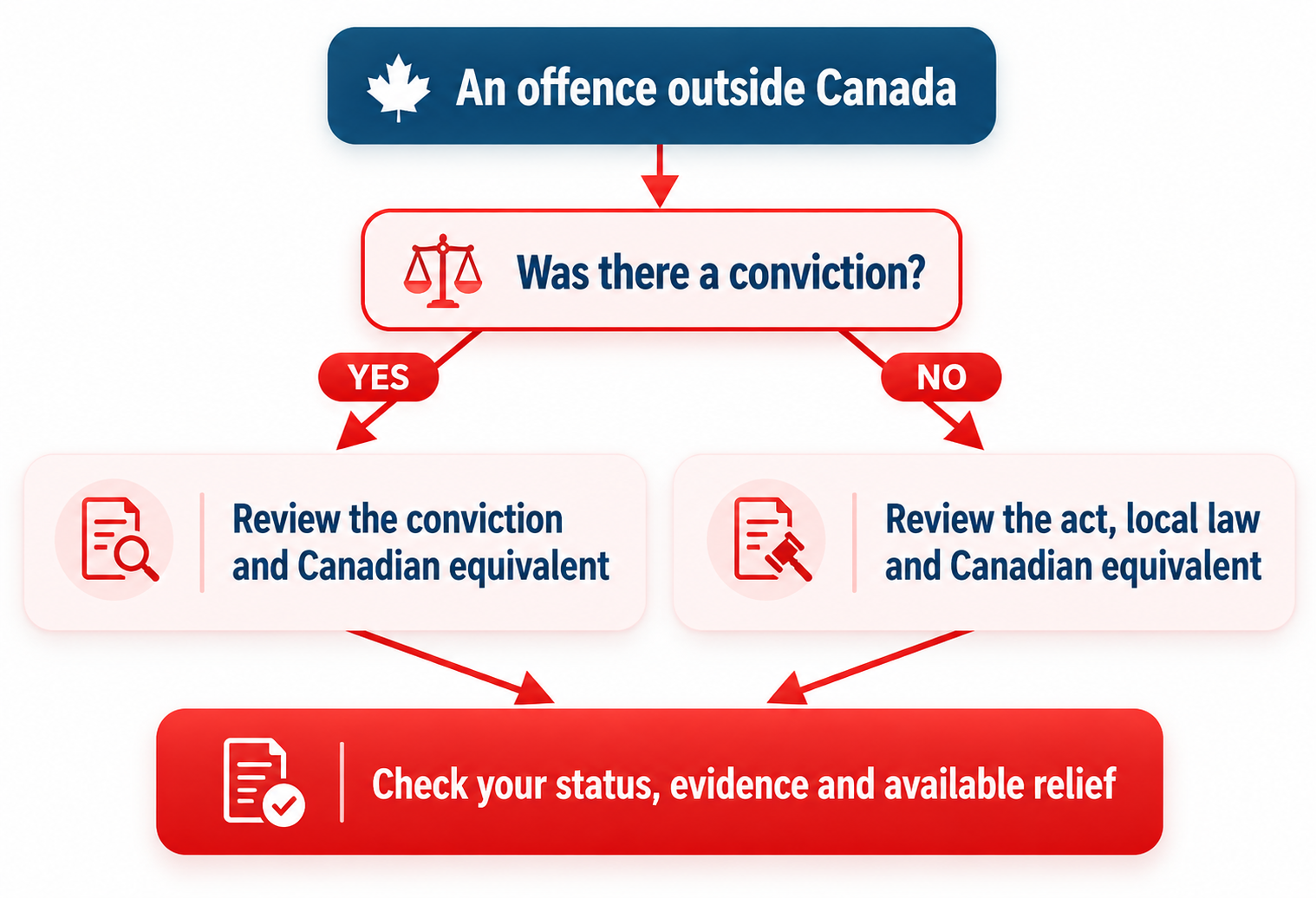
Conviction outside Canada | A conviction with a Canadian federal equivalent carrying a maximum prison term of 10 years or more. | One conviction with an indictable Canadian federal equivalent, OR two convictions from separate occurrences with Canadian federal equivalents. |
Act outside Canada without a conviction | Conduct constituting an offence where committed, with a Canadian federal equivalent carrying a maximum prison term of 10 years or more. | Conduct constituting an offence where committed, with an indictable Canadian federal equivalent. |
How to review overseas offence
The name of a foreign offence does not settle the immigration issue. To examine the foreign law, the facts and the essential elements of the relevant Canadian offence. This comparison is known as criminal equivalency
Which Route Needs Review
5+ Years
Individual Rehabilitation
For eligible foreign offences. Usually after sentence completion or the relevant act. Approval required.
10/5 Years
Deemed Rehabilitation
10 years: certain single foreign cases.
5 years: quality summary cases.
All legal conditions must apply.
TRP Temporary
Temporary Resident
Discretionary permission to enter or stay. The officer weights your need against risk. No permanent clearance.
CANADA Convictions
Record Suspension
Review eligibility through the Parole Board of Canada. A valid suspension covers the conviction.
Court Outcomes Matter
Final acquittal or Canadian discharge
Review the exact court outcome before relying on an exception.
Foreign pardon or discharge
A foreign outcome does not automatically resolve the Canadian issues.
Youth sentence or designated contravention
Special exclusions apply, Review adult sentences seperately.
Evidence and the burden of proof
An admissibility hearing takes place before the Immigration Division of the Immigration and Refugee Board of Canada. The burden of proof identifies who must establish the legal position. The standard of proof identifies the level of evidence required.
Your status at the hearing | Who bears the burden |
Permanent resident | The Minister must establish inadmissibility. |
Foreign national authorized to enter Canada | The Minister must establish inadmissibility. |
Foreign national not authorized to enter Canada | The person must satisfy the Immigration Division they are not inadmissible. |
The Minister normally presents the inadmissibility case first. The order of presentation does not change the burden of proof. These rules concern admissibility hearings, rather than every immigration application or appeal.
The standard of proof
- Under section 33, the relevant facts for sections 34 to 37 generally require reasonable grounds to believe. Credible evidence must support more than suspicion. This standard is lower than proof beyond a reasonable doubt.
- For a permanent resident under section 36(1)(c), section 36(3)(d) requires a balance of probabilities. The evidence must show the person more likely than not committed the foreign act.
Refugee claimants found inadmissible for serious criminality (s. 36(1)) are ineligible to have their claim referred to the Refugee Protection Division (s. 101). Protected persons can lose status through a removal order, but the Refugee Convention exclusion and non-refoulement rules add limits.
Bring these to your consultation
Court Outcome
Charges and Final orders
Sentence Completion
Date and proof of completion
Immigration Letters
Notices and Deadlines
Questions before you apply
Does an old conviction stop affecting immigration
Age alone does not resolve inadmissibility. The offence, sentence, later history and legal conditions determine whether rehabilitation or another exception applies.
Do I need an assessment if I never went to jai
Yes. The maximum penalty, offence classification or foreign conduct still creates a potential issue even without a jail sentence.
Where does the waiting period start
For a foreign conviction, review every sentence component before calculating the date. Probation, parole, unpaid fines and court-ordered driving prohibitions affect the calculation. An act-based case uses different rules.
Does approval of rehabilitation guarantee entry
No. You must still meet the other entry and immigration requirements. A TRP also provides temporary permission only.